

Interview With Bryan Groleau
Spotlight Series Topic: Lymphedema Management
Guest Name: Bryan Groleau
Guest Credentials: COTA/L, CLT-LANA, WCC, LLE, CLWT
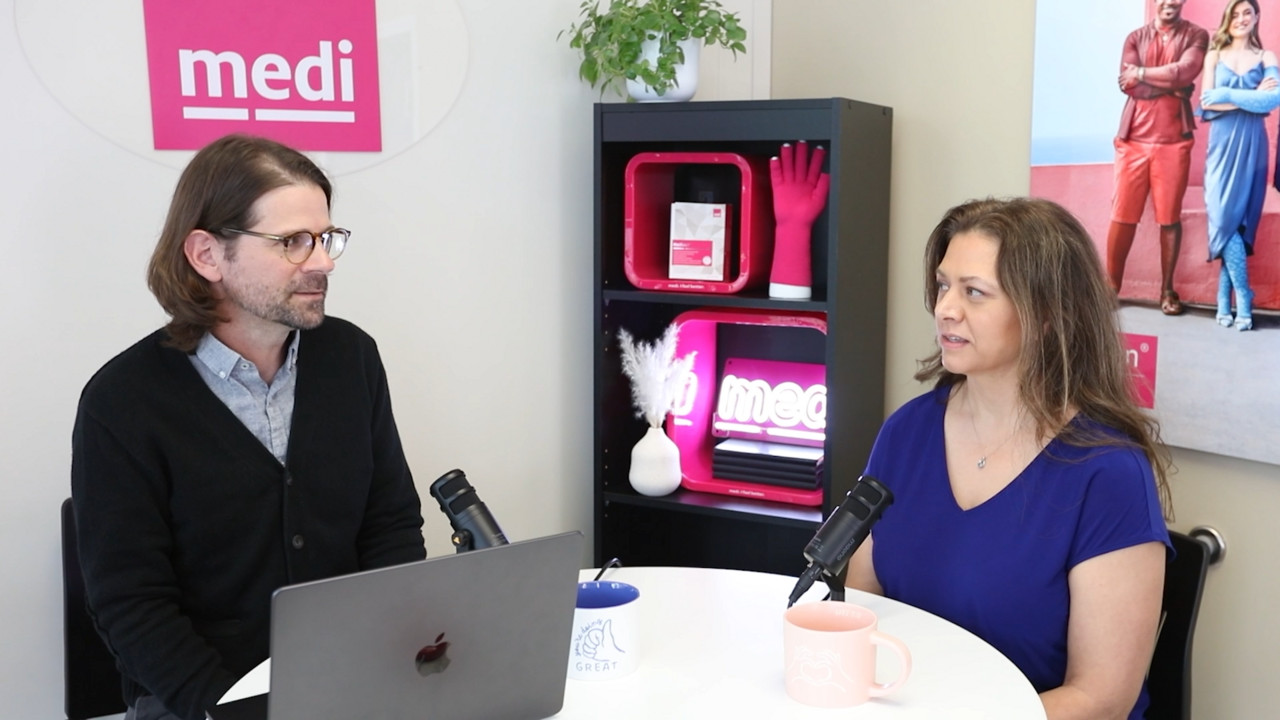
Discussion Details: In this episode of The Magenta Lounge, Bryan Groleau sits down with Denise Comiskey, founder of Pathways Therapy Services LLC, to discuss her holistic philosophy for lymphedema management and why every treatment plan should be tailored to the unique needs of each patient. Denise also shares the inspiration behind the Pathways Education Program, a comprehensive educational platform designed to strengthen CDT foundations while providing advanced training opportunities for clinicians looking to elevate their practice.
Hello there. I’m Bryan Groleau of Medi, and I am your host of the Magenta Lounge podcast. You are about to listen in on some great information brought to you by MediUSA.
And I’m excited because I think we’ve got some really incredible guests coming to the table that we can get to know a little bit, hopefully learn a whole lot more from.
But I need you to know a few things before we get started. And that is really that the information and the education that we bring to you in this program may not be the opinion of many USA’s or even mine, for that matter.
Nonetheless, I think you’re going to hear some great information and some great protocols, and they are going to be inspiring. And if they do inspire you, bring them back to your care teams and your physicians and decide that collectively. No one is here to tell you to override a physician’s order or a whole team’s assessment, right? We always want to make sure when we hear new information, we’re doing our own intel. We’re doing our own research, and we’re bringing it back to a team of people that are in agreement with that.
So, I’m excited to get started. Again, thank you so much for being here, and I look forward to bringing you all these programs.
Hello everyone, and welcome to the Magenta Lounge. I am your host and friend Bryan Groleau, and I’m the director of clinical education here at MediUSA.
My goal is simple. I literally just want to pass along good information that you can utilize and walk away with that’s going to help you treat your patients better and set them up for lifelong success. There’s a lot said in doing that; easier said than done, I should say. And my journey in lymphedema started years ago in 2003. And the answer to that question I’ve been trying to answer for many, many years. How can I set patients up with the best long-term situation, and also how can I treat patients better? What are the updated protocols?
What are the best approaches? All these questions are out there, and I don’t have all those answers, but through the years I have met tremendous people, and I want to bring those people here on this program so that you can learn from them as well. There’s so much to learn from so many different people, and they all have their passion and their expertise, and that’s what it’s all about, and that’s why we’re here today.
So, I’m excited to introduce you to my guest today, whose name is Denise Comiskey. Denise has an approach to lymphedema that I find to be very unique and very necessary. One thing about Denise is that she has not forgotten her roots as a therapist first. She’s a certified lymphedema therapist and Lana certified. She’s wound care certified. She does vestibular rehab, and she has her own practice. She does so much on her own, and she does all of it excellently. Um, but in talking to her and the time that I’ve got to spend with her, I’ve just realized, wow, these are some really good insights that I think a lot of us could learn. So, with me today is Denise. Denise, welcome to the Magenta Lounge. Thank you so much for being here and making the time for us.
Thank you, Bryan. I’m very happy to be here, and we get to talk about lymphedema. I can do that all day.
Yeah. All day. Yeah. I I I say the same thing. Yes.
And I say that, and I think people think I’m joking, but uh, actually it’s kind of what we do. We’ve, like, thrown our energy and life into this. So, yeah, I literally could talk about it all day, but don’t worry, we will not do that. We’ll condense it down. So Denise, like I ask everyone their I I ask everyone their story because I feel like ending up in lymphedema is a one-off, even though there’s more of us out there and you’ve made more of them. One thing I forgot to mention is that you’re an instructor for the Norton School of Therapy. Um, we’ll get into all that stuff, but goodness, finding the niche of lymphedema in itself. Like, tell us your story, how you got here.
We’ll dive in. Yes, it was like you said many moons ago, but I do remember the patient distinctly. Um, I was doing mobile care. I was going into patients’ homes. Um, one patient in particular: I went in; she lived alone.
She was getting wound care from nursing, and I went to do something with her transfer or and I just remember both of her arms had gauze wrapped around it but this clear fluid just started leaking out and I thought, okay, whatever the nurse did wasn’t working. Several visits later, it was the same thing. It was just bandaged but soaking through her clothes. And this was probably mid-2000s, 2007, like we’re in the 21st century. We have to have a better treatment for this. So I started seeking out, you know, what is it, fluid? You know what the swelling is, and it led me eventually to 2009, when I became certified in lymphedema therapy.
Nice. Nice.
And I’ve been treating patients with lymphedema ever since.
That’s so awesome. And I love that it all started with a need. You were treating a patient who had something you didn’t quite know how to treat, and you didn’t just pass it off to somebody else. You said, “I need to figure this out.”
And that sparked a whole bunch of other things to get you to where you are now.
Yes. Also, you mentioned the wound, and I have that I I also have that same story of, like, okay, 3 months into being certified, I have this gigantic venous leg ulcer on the table. No idea what a venous leg ulcer is, by the way. I just know that it’s a wound and there’s hyperkeratosis all around it. Again, I didn’t know what that was either. Yeah.
And I’m just like, oh my gosh, what do I do?
Fortunately, I had a good mentor in those days. And, uh, but I know that for me I had the same kind of thing of like I have a wound. Yeah.
I could call someone up and refer or I can figure this out. Right. And I love the figuring out part.
And that’s the investigative that was the detective work. Um all and but this person was already getting people in. So it wasn’t even trying to pass off. They were already being passed off. And you’re like, yes, the buck stops here. We, someone has to do something there. We could do better. Yes. And I can figure that out.
Yeah, for sure. I love that. That’s really cool.
So, uh, tell us a little bit about your lymphedema career. Okay. So, you have your own practice.
Yes.
Um, and I know you started that brick-and-mortar recently. Tell us a little bit about that. but also want to know about your journey in being an instructor, okay, of lymphedema. So for those of you out there, if you if you are Norton trained, there’s a good chance Denise here has been your instructor. So hopefully, for those of you that have been trained through Denise already know what a wonderful instructor and wealth of knowledge she is, but give us a little background on that. So, treating lymphedema, um, for many years, seeing wounds. That’s why I also got my wound certification. Um, not something I thought I’d go into, but something you just stumble on and you have to do it, which I love now. Um, but I was doing mobile therapy for a very long time. And I wasn’t able to see more people. So, I couldn’t help more people. I can only see so many. The drive was starting to get longer.
Um, I couldn’t add any more people onto the day, right? So, after more than a decade of doing mobile care, I decided just to take the leap and do the brick-and-mortar, um, which we’ve had open now. Um, and I love I mean, I see so many more people. I can do many more things. And it’s not about the equipment that I can put in the clinic, but um the time spent with them, but also um besides treating patients, I do workshops for the community. So, one Saturday a month, I will have a lipedema workshop. So, it’s free to the community, and it’s all about education. Cool.
Um, because that was one of the things I loved about treating people with lymphedema is educating them, educating their caregivers. Um, most of them never even heard of lymphedema, even from their doctors. It was something’s wrong with your arm, something’s wrong with your leg, go get treatment.
Um, so just educating them about it. Um, and now educating the community, which, um, I absolutely love. Again, a free event. I have a women’s support group. So, it’s for women with breast cancer living with lymphedema. They call themselves the Pink Coconuts because we’re in Florida. So, that’s awesome. Um, we have a logo and everything.
Nice. That’s so cool. Um, but it’s just to bring them together to let them know they’re not alone.
Breast cancer is one thing, but then lymphedema on top of that. So it’s, um, that sense of community, that sense of again not being alone, um, has helped so many of the women.
Um, but education. So I never in a million years would have thought I’d get up in front of a classroom and speak. Um, but I actually so enjoy it. Um, and since 2018, I’ve been an instructor for Norton. It’s amazing.
For the CLT certification, and I I so enjoy it. So, interacting with so many different disciplines all over the country, and it just definitely has made me a better clinician.
Um, being able to teach them the foundations and just reinforce the foundations for myself.
Very cool. Um, I think it’s an incredible background training people to become certified lymphedema therapists.
And I think that kind of leads me into my next question for you is I know you have started your own education platform. I’ll let you talk about that, um, and what it’s called, but as an instructor of or or creating certified therapists, it sounds like now you are teaching advanced courses. So that these now-certified people can get to the next level. Correct. So, tell us some more about that.
So, um, I rolled it out this year. Um, Pathways Education Programs, um, my first course that I’m offering, it’s a 3-day, um 24 hours um for advanced advancement in being a CLT. Um, the need was that after I would see the students for the CLT course, they would contact me 3 months later, 6 months later, okay, what do I do with this person? What do I do in this situation? And it’s not the same questions from all the students, but it’s questions, and either they don’t have the mentor, they don’t have the support in their facility, um, or they just run into complicated cases, which, yeah, we all do cuz it’s people we deal with. Yeah.
Um, so I definitely found the need to go outside the textbook, go outside the, you know, formal learning. Mhm.
Um, I try in the courses to bring out my own case studies just to show them real people, what really happens. Um, but yeah, you run into so many comorbidities or something else that’s going on. So we need to address that. It’s not just lymphedema. Treat it, be done. Um, but I’ve also found that when I started assisting and then instructing, over the years I kind of waxed and waned from the foundation. Um, and it happens to all of us as we’re people. Um, so I think therapists need kind of that reboot: really, what are you doing with your bandages now? What did you start to take away, or what have you changed just because your admin told you to?
Totally. Um, so having to kind of dust off the book, go back to basics. Um, but then learning how to treat, you know, changes in cancer treatment has changed how the book has taught us. Sure.
Um, and we may not have all the updated information, but I see I don’t see, maybe, limb lymphedema. I do see now trunk more than we used to, you know, decades ago. So absolutely, um, seeing these changes because of how medicine changes, we have to stay updated. Um, and we need support. Most of the clinicians are out in the wild by themselves.
Um, so you know, the webinars are great.
I’m not taking anything away from the online learning. But I see it as these therapists need someone next to them. Here’s how your hand should look. Here’s how you should stand, even. I mean, yeah, that makes a big difference in how you treat someone.
Amazing. Well, that’s incredible. And with that, I have a lot of follow-up questions for you because I I think it’s perfect for what’s needed out there. Um, and with your experience and your instructing experience, you are the perfect person for it. So, let’s talk about that.
Before we do, a short little break from our sponsor, who happens to be Medi.
We’ll be right back.
Medi compression garments are a big part of my life. I’ve been wearing them since I was a little girl. They really help me live life in the sense that they control my swelling and keep it under control. They’re very comfortable to wear. I can’t live without them, to be honest. And I really do love the fact that they come in so many different colors and patterns.
The new Medi compression glove that I’m wearing is seamless now, and I love the material on it. It’s very flexible.
It makes it easier for me to move my fingers, and that really helps me do daily activities more easily. Um, it’s like a second skin.
All right, everyone. Welcome back to the Magenta Lounge with our special guest, Denise Comiskey. Uh, Denise, I want to jump into your approach to lymphedema therapy because, as I said earlier, I think it’s a unique approach. You’re integrating not just the lymphedema therapy, but you’re looking at the whole person and a very holistic approach, I would say. So let’s talk a little bit about how you jump into this with a patient.
Um, as soon as they walk through the doors it’s you’re analyzing as a therapist. You’re constantly, um, assessing.
Um, but it’s simple. It’s an individual approach. Um, even if I’ve seen the same diagnose 10 patients before. You have to look at the person. You need to know what their issue is, what their problem is, what they came to you for, how you can help them, and then work on the goals together.
And again, it’s not just swelling or the wound. There’s other issues going on.
Again, they’re people. So, you know, they have the mobility.
Maybe they’re socially isolated. You know, maybe they’re falling.
There is something else, as therapists, that we can and should help them with.
Um, and sometimes that’s priority. I’ve had people whose fall risk was too great. I couldn’t bandage their leg. And that was okay because I worked on the fall, the fall risk. I worked on their balance, their strengthening. I think we, as therapists, and maybe it’s from administration, I don’t know, but we want to jump in and just do our MLDD door managing and then move them on, right?
But you can’t because they have so many other problems. Maybe that’s what got them into this situation, right? Um, so every person should be treated as such, as a person, and you know you can include CDT as part of it, and that’s a big part, but that’s not the only part.
Um, I typically will see someone; I do the evaluation. It’s all education. I do my measurements, my assessments, but I find out, okay, what are we trying to get?
we trying to reduce? We’re trying to get the wound healed, um, or we’re just sticking to maintenance. We want to just preserve the limb and not let it progress. So, it depends on what our objectives are. Yeah.
Um, if we’re going to reduce, then we need to just step into CDT if they’re ready for it. And I talk to them before they come for a visit, before I even touch them.
Yeah.
Are you ready to commit? If you’re not ready to commit, we need to find a time when you are, because I can’t be the only one. Yeah.
Giving in this situation. Um, so I I we talk about, you know, maybe someone is going on a cruise in a month, and they can’t commit until after the cruise.
Okay, come back. Yeah.
Um, I’ve had some people I need I need to find transportation. Fine. Come back when you have transportation. We try to help them as much as we can. Um, I have an awesome person in the office.
Oh yeah. Tell us about that person.
Um, that person is Comiskey. He is the business um manager. So he’s also my husband. So I have to give him props. Um, but no, but if you know we we do help them as much as we can, um, with what we’re given and our limited resources. But yeah, they come in um, they have to know the schedule.
You know, I’ve had people say, “Well, I can’t come that often to see you.” Okay, well, this isn’t for you.
You know, when you can commit, let’s do this. But I’m not going to water down a treatment just because I got to fit around their soap opera times or whatever. Whatever. They want to, um, make an excuse. This is health.
This is for their health. This is long-term. This isn’t going away.
So when they’re ready, you know, I’m here for them. And I tell them that you can come back anytime. If they’re ready to start, we get them on the schedule and we just, you know, do the whole CDT.
Yeah, I think it’s pretty obvious that your lymphedema therapist, you’re seeing lymphedema patients. Obviously, the goal is to reduce.
Mhm.
But like there’s such a bigger picture there that you’re looking at. Uh, obviously you mentioned the fall risk.
Um, but whatever’s going on in their life, you’re looking at them when they walk through the door. So how much what do your goals look like? Like, what does your assessment look like? Are you writing goals that say we’re going to reduce by this many centimeters here?
We’re going to, um, we’re going to do MLDD and, uh, try to, I don’t know, fit into a shoe better. Like what like what are the actual goals? I think people want to know how to write a proper assessment.
The reason I bring this up is that we live in an LTA world now. Yeah.
And documentation has always been important. We’ve always tried to be that into people, but now it’s like if you want that garment, right, you have to document why it has to have a real purpose, right?
So, what is your what do your goals look like?
So, that is part of the course. I did go over documentation, assessments, what assessments you can do for certain areas. Um, but yes, the goal has to be that you just can’t say reduce. Yeah.
Because insurance companies want to know why, or the payer wants to know why.
Um, so reduction is to prevent a fall risk. So their limbs are not heavy. Um, the reduction is for the arm to fit into regular clothing because most of the women will say I have to buy a size up just to fit my arm into it. So, um, it can be so they can self-feed themselves. Um, the head and neck is more specific.
Um yeah, that is something I do treat but not um as often.
You mentioned trunk too. I wouldn’t have a I would. How do you document that?
So to measurement wise assessment wise um, you just have to find points on the body to, um, make measurements, but, um, again, fitting in clothing so they have the mobility to do, um, movements, um, to do self-transfers. So if you can’t move your trunk because it’s swollen, you can’t get yourself out of bed yourself; you can’t put shirts on, um, things like that. Um, so it has to relate to function because, yeah, we’re drilled into our heads as therapists and um the wound, but the wound, you know, why does the wound need to be healed? To prevent infection, but also so they can go out in public, to go to the grocery store, or so it should all be tied. Um, skin care is always a goal of mine. Um, if I’m doing edema reduction, edema reduction, but why? So they don’t fall when, you know, they can put their shoe on. Um, uh I do I’m trying to think what other goals that you know, I assessment goals. So if I do an assessment, they have to be able to, if it’s the time, get up and go; they can have better mobility, um, to safely
transfer. So I don’t just do edema reduction. It is definitely more; it encompasses the whole of the person. They can do their own skin care um maintenance. They can put they can identify what maintenance is for a short-term goal, and they can actually perform the maintenance.
So I don’t cut someone off, get their garment, and discharge.
They have to have their garment. I need to see them back. They need to show me they can wear it. It fits. They like it.
Um, I typically will see someone through the intensive phase, but as an outpatient clinic, I see them 90 days. I will typically see them for the whole time. I titrate the visits down so I don’t see them five times a week. That’s only initially. We go down to three times. We transition to maintenance, and then once they’re in maintenance, they can come twice a week. Yeah.
Um, usually I’m working on other things, though. I start working on their balance. I start working on their strength.
So your typical protocol for a standard lymphedema patient is you start off at five times a week.
Yes. And again, I say this during the evaluation with my patient because, yes, they can scoff at that. You want me to come how often? When I put the bandage on the limb for reduction, the limb will reduce, but the bandage does not reduce that much. So if I bandage someone Monday and don’t see them until Friday, their limb will reduce, but by Friday it’s going to swell back into the bandage; you have no gains, right? So when you hear people oh I’ve been six months at a clinic with bandaging on.
Yeah, you probably have, and you probably haven’t reduced much. You have to do it five times. You have to get the biggest bang for your buck; it’s five times a week.
Yes, the weekend. I hear that a lot.
Yes, wear it. I don’t work weekends, and you have to wear it until Monday. Other things can come into play for the weekend.
Um, but you will see the biggest reduction the first week. I measure every week. If I don’t see a reduction, I stop what I’m doing, and I have to change. I tell someone, I’m not going to just treat you to treat you. If you’re not reducing, we’re not improving. We have to stop and see what else is going on.
So, the first two weeks are typically 5 days. At that point, usually the second week, they don’t reduce as much, or if they’re willing and they’re still reducing, we do a third week. And then as soon as we have that slowdown, that plateauing of measurements, then we can go down to maintenance. We switch to it, but I still have to bandage, which means I order; we order, we come to some agreement on what we’re going to order.
At the end of the intensive, I’ll measure for custom, for Velcro, for whatever they need. And then I still bandage them to maintain that reduction.
Most of the time, they don’t have anything to go into. Um, so I still have to bandage them just to prevent that edema from coming back. And then once they get all their supplies, again, we can go down to twice a week, but I got to make sure they’re wearing it like they say they’re supposed to.
Um, that they can get it on and that it’s working cuz they can wear it, and maybe the first week it doesn’t work.
Excuse me. So then I know, okay, we need to do something different. So it has to be a maintenance that works as well.
Yeah. And within that scope of practice, you’re addressing lympadema, but you could also be doing balance training or regular OT, correct?
Implemented into that treatment. So, it is fully comprehensive- yes, you’re an OT, yes, you’re a CLT, but you’re merging all of it together into one approach, right? And so, depending on whether, you know, the CDT would become primary, we do the five times a week, but once we start going down less and less, switch to maintenance; then you start to work on, you know, how is their strength, how are they reaching, you know, are they able to functionally move in and transition. So yeah, we work on, you know, just stretching, just to get that sock on, to bend over, make sure they’re cleaning between their toes. Make sure they can lift their arm over their head to get the microwave.
Um, so yeah, we start working on more traditional therapy.
Nice. Well, that’s amazing. Um, I think that’s so important for everyone to know, just because I think we learn to be CLTs and we go after that. And there’s just so much going on with an individual. You do have to just take every patient and customize their treatment, right? So, it makes total sense.
Very good. All right.
MediUSA welcomes some amazing new additions to our custom circular profile line with enhancements like the easy grip panel on the sole of the foot for safe mobility during the night hours.
Slim channeled foam in addition to our classic foam, for a slimmer fit.
The option for soft foam as well as classic foam to address variations in fibrosis.
And the ability to integrate our easy band and easy band lift for endless adjustability. Our nighttime compression is more comprehensive than ever.
Go to mediusa.com for more details.
All right, Denise, I want to switch gears just a little bit. Of course, I, uh, you know, I’m going to talk about compression. How could I not, right? Um, but you also heard me say, and I say it all the time, like the maintenance phase of treatment is so important cuz it’s it’s lifelong. And I feel like experts like yourself and me, and lots of therapists out there, we provide amazing therapy. We do a great job with limb reduction, but then we have to shift that to the patient. And that is a task in itself and really difficult. I mean, there are so many, uh, there’s a lot of different choices out there in compression, but there’s also a lot of different aspects about the patient that might hinder them from going into the compression that you might want them in. Right?
There are just so many aspects about it, and I want to talk about it. I want to talk about how you look at setting someone up for their maintenance phase and what choices you might offer somebody or how you just decide all that. It’s a big It’s a big uh question.
It is. It is, but I take that from the very beginning. The first visit that I see someone again my evaluation is mostly education but that’s exactly what I go into. I start talking to them; the reduction is the easy part. The maintenance is what we need to start talking about.
I tell them there are different options; we need to not decide right now, but we need to start thinking about what we are going to transition into. So we don’t have to make the decision on which color and which, you know, cut and which length. We just need to know what do we think we can do.
So you’re from the start preparing them for what they’re going to need in the future. You’re not just waiting until now you’re going to go into garments.
No. Because the education they need to know what they’re getting into.
Yes. If they come and they think, “Oh, I’ll just get my massage and bandage and be done in a week.” No. Again, this is lifelong and I’m here to help them. We can make that decision together.
It is ultimately their decision. They’re in their families, their caregivers, but let’s start thinking about it so this can be an easier transition.
Mhm.
Because this will happen quickly once we reduce. I need to get measurements. I need to get the order out, and then it needs to come in. They need to start wearing it.
So, we have to look at a lot of different things. Ideally, I think for most people with swelling, flatten it is pretty much the gold standard, but you have to take into consideration what they can do, their lifestyle. So, if they can’t pull on a thigh-high flatnip because they’re 80 years old with arthritis, we need to think of something else. So, there are great products out there. Um, outside of flatnip, we can do Circade; we can do Velcro. Um, again, we can do combinations of it, but it just depends on their ability, and really in the end, what are they going to do? Right, right, um, you brought up flatnip which is awesome I love flatnip; it’s our go-to at Medi. We talk we do a lot of talking about our flat nets and we talk about it in terms of containment but I think there’s still a lot of people that are maybe utilizing circular net comments on Yes. Um, circular knit is really not meant for people with swelling. So,
there are usually two most common complaints when someone, oh, I bought this online. I bought this at the store.
I have pain at the ankle, the instep, because it’s digging in. I have pain at the top because it’s causing this tightening, this tourniquet. Um, those are common, I think, across the board.
Um, they don’t fit right. They don’t contain them. They wear them. They’re like, “At the end of the day, my foot and my ankle are still swollen because the containment’s not right.” Containment.
So, circular is really meant for legs like yours or mine.
Um, the flatnit is for someone with swelling. Not only is it custom-made, but it prevents the digging in. It prevents the tourniquet.
Um, and the containment is such a big deal. And I show my people who are in my clinic; I have the two different kinds. I show them what the circular one feels like and looks like. I have them touch it. What the flatten it looks like. So, the containment on a flat, um, I explain to my patients that if you have a pitcher of water and you pour that pitcher of water into a plastic bag, that bag is going to expand with the water. It won’t leak, but it will expand.
You can take that same pitcher, the same amount, pour it into a glass cup, and that wall doesn’t move. That containment is going to hold. And that’s the flattenet. The flattenet is the glass. It’s it’s going to keep that swelling from happening after 12 hours of standing on your feet.
That’s an incredible visual and so accurate. Um gosh, that’s a mic drop right there because it’s like what we spend so much energy teaching people at Media, and I’d love to get that word out there. It’s nice to hear it from you. Um, because it’s just singing our song, you know, the amount of energy we put into that. We know containment is an ingredient that’s been missing from compression for a long time, and we are talking a lot about it, but we still see a lot of people choosing circulation.
So I think we’ve got to we’ve got to tip that.
And it’s the education, and again it’s big for me. I think if you can educate them, tell them why that helps them make better decisions. Yeah.
Because if you just tell someone to do something, they end up usually not doing it.
I was never that way. So if you give them, you know, you give them the information to know the why.
Yeah.
It’s they’re more likely to follow through.
Why? Absolutely. That’s where the education, to me, is everything. You can educate on how and what, but if you educate on the why, you’re getting at a different outcome.
And you need to bring it to their level, whatever their level is. If I’ve treated surgeons, I’ve treated someone who’s never had a high school education. So, you have to make sure they understand. So, same with teaching, you know, other therapists, CLT. It’s if I can’t make them understand, I didn’t do my job.
Yeah. And just me saying words is so different than having you actually understand right what what words are coming out of my mouth.
Yeah. Um, I want to get into a little bit more detail on specifics of product choice.
Okay.
At Medi, we have different flatnips. We have different levels of containment.
And you mentioned Velcro as well, circuit. And I’d love to know where all that falls in levels of containment or how you utilize it.
For the flatnip, um, depending on really their mobility, um, how active are they? Are they sitting all day at a desk? Are they able to pull up the flatnet? Um, if they cannot physically put a flat on, we definitely go to the circade.
Um, the Velcro. But again, I don’t just give them a Velcro circade and say, “Here you go. Here’s your maintenance.” Yeah.
They need to come back. I need to make sure they’re pulling the straps correctly.
Um, they have the sequence down.
So, again, you can’t just discharge someone with a garment and say, “That’s it. You succeeded. You graduated. You’re done.” Um, they need to come back because over time, they start to lose how to put it on, right? Oh, I forgot the liner. I just put it on against my skin. So there are so many factors to continually look at.
So if flatnips are hard, which they can be hard to put on, if they don’t have the mobility, they have a lot of back pain, they’re elderly, they, you know, they can’t bend over, Velcro is a great alternative. So circades are, um, awesome for any limb- arm, leg- but they definitely need to know they can put it on, right? Mhm.
Um, but it’s also used for, I found with um my patients that are going through active chemo, Velcro is a great alternative because with their chemo infusions, they’re getting a lot of fluid pumped into them, and they need that adjustability. They need containment, but it hurts because they’re getting all of this fluid, which I can’t control. So I have to allow a little bit of give. Velcro has been um, the circades have been a great alternative, um, for my patients going through active chemo. Yes.
So you can use it for not just your elderly. There are so many other things.
It’s great for wounds. Circade is a great product for wounds, and then you can use that for nighttime or for their maintenance, um, in that aspect. So you do have to you can do a combination. People can get Flammazine and Circade.
Yeah. So, don’t be afraid to use both, to have both.
Nice. Yeah. Um, adjustability to me is a big deal when you’re dealing with fluctuations. And I always have kind of taught that somebody can determine how swelling is going to respond based on what the bandaging is, right? If they have a fast reduction, if they have a quick refill, you’re assessing how bandaging goes. You’re assessing how the decongestive phase goes. Depending on what your tool is for decongestion, you can determine so much on that. Yes. To determine what your maintenance phase is going to be and what that needs to look like and how intense it has to be.
I even do some trials, maybe on one of the last weekends. They’ll take it off and see how they refill at night, even. So, some people may not need a nighttime garment. Some people do. So, we can do trial and error. I know I can fix their swelling cuz they’re coming back to me the next week. So, if we do a trial and error and it doesn’t work out, they’re back to see me. I can still take care of everything.
Nice. Well, I think we have learned quite a bit from you, and I really appreciate you being here and offering your knowledge and your past and what you’ve learned through it.
Uh, just like me, um, your approach to therapy and utilizing all of your OT and lymphedema, we’re looking at the patient from a whole perspective. I think it’s something we all need to know, remember, and consider when we’re approaching these patients. So, what I want to do in closing is just briefly talk about the education platform that you’re working on because I know you have a course you’re putting out there, and I want people to know where they can find you to get those skills that they’re that they want to advance to. I mean, you you you’re working with newly certified lymphedema therapists all the time, and like we said earlier, like you want to help people advance. So, tell us about what you’ve got going on, where you’re holding classes and all that good stuff.
So, it’s you can visit the website pathways411.com. Um, I do offer it’s a three-day course, 24-hour contact hours. Um, it’s in my clinic, um, outside of Orlando, Florida.
If you do not, that’ll be rough.
Yeah. Yeah. If you do not want to travel to Orlando to see the parks or the beaches, um, I do want to bring this to the community. So, I’m offering um hosting opportunities at your facility, at the universities. Um, I want to bring this course to you.
So, everything with it, it talks about manual techniques. It goes over advanced manual lymphatic drainage. It goes over bandaging. Making sure you can put a bandage on.
I’m nervous. If I come to your class, what am I going to expect? Are you going to slap the slap wrist?
I won’t be judgy, but I am going to make sure you do it right. When you leave, you will be confident in how to put on a bandage.
All right, I will sign up. Uh, we go over documentation. We go over making sure you know what assessments need to be done, how you should, uh, word your goals. Um, everything needs to definitely line up with LTA. How do you do that?
The billing codes, the CPT codes. Um, so it’s it it encompasses the whole treatment of a person that has lymphedema.
Nice. Well, awesome. And, uh, it sounds like a perfect opportunity for those people that are out there that maybe don’t have the opportunity of mentorship or are just new at this, uh, they’re newly certified, whatever the case may be.
Uh, I’m going to be there. And I’ve been doing this, like I said, for a long time, but I guarantee you I will pick something up from you that I didn’t know before. I’ll be uh I’ll be a little bit on edge, though. I’m just getting I’m going to make sure to call you out.
No sitting in the back end. Well, thanks for being here, Denise. So much appreciated. And thanks for all that you do. And uh, thanks, everyone for listening in today.
Thank you.